
Plan six export cartons and 216 pieces for this two-product order: three cartons of the elephant building block contain 144 pieces, while three cartons of the electric guitar toy contain 72. For wholesale toys in bulk, convert each product’s carton minimum separately before adding the order totals. The catalog dimensions produce a combined planning volume of 0.81030 cubic meters. Confirm the quoted pack configuration before ordering, then replace planning figures with final packed measurements before shipment.
The catalog minimum is three export cartons per SKU—not three cartons shared across an assortment. The October 17, 2026 catalog packing references are planning inputs, not guaranteed shipment specifications.
What does the six-carton purchase worksheet contain?
| Modular elephant building block — TF10703 | 48 pieces/carton × 3 cartons = 144 pieces. Catalog carton dimensions: 64 × 37 × 55 cm. Calculated volume: 0.13024 CBM/carton × 3 = 0.39072 CBM. Catalog-listed volume: 0.13 CBM/carton. |
|---|---|
| Electric guitar toy — TF10704 | 24 pieces/carton × 3 cartons = 72 pieces. Catalog carton dimensions: 70 × 37 × 54 cm. Calculated volume: 0.13986 CBM/carton × 3 = 0.41958 CBM. Catalog-listed volume: 0.14 CBM/carton. |
| Combined purchase plan | 3 + 3 = 6 cartons; 144 + 72 = 216 pieces; 0.39072 + 0.41958 = 0.81030 CBM calculated from catalog dimensions. Using the catalog-listed CBM figures gives 0.81 CBM. |
How does a carton MOQ differ from a piece MOQ?
A carton MOQ sets the minimum number of cartons per product; its piece equivalent changes with the confirmed packing configuration.
Here, the same three-carton minimum produces 144 pieces of the building block but only 72 guitar toys. A single piece minimum applied to both products would misstate this order.
A minimum is not an order multiple. These catalog references do not establish that every larger order must increase in three-carton steps, or that every requested quantity must be rounded to full cartons. For a quantity above the minimum, have the quote state the accepted quantity and packing arrangement.
Customization is quoted separately. If a requested retail box, assortment or other packing change alters pieces per carton, recalculate both the piece equivalent and volume using the customized quote. Do not carry the standard catalog packing figures into a changed configuration without confirmation.
How should buyers calculate and measure carton CBM?
Calculate CBM from the closed carton’s outer length, width and height, using the same measurement unit for all three dimensions.
For dimensions in centimeters: CBM per carton = L(cm) × W(cm) × H(cm) ÷ 1,000,000. Multiply that result by the number of cartons sharing those dimensions, then add the product-line totals.
Measure the external envelope at the longest points, including corrugated thickness and any bulging. Inner box dimensions describe packing clearance, not the space occupied by the shipping carton. BoxYourBrand
Explicitly hypothetical example—not either product’s packing specification: assume six identical closed cartons each measure 60 × 40 × 50 cm. Each carton occupies 60 × 40 × 50 ÷ 1,000,000 = 0.12 CBM; six occupy 0.72 CBM.
The worksheet’s five-decimal results preserve the arithmetic; they do not imply that catalog dimensions were measured to that precision. The catalog-listed volumes are rounded relative to the dimension-based results. Neither calculation establishes final shipment volume or palletized space.
What packing information should be agreed before the purchase order?
Agree a proposed packing specification before the purchase order, then treat the final packed measurements as a separate shipment record.
For each product line, record the pack configuration, pieces per export carton, ordered cartons, total pieces, proposed outer dimensions in centimeters, proposed gross and net weights in kilograms, carton construction and shipping-mark artwork. Identify any customized configuration explicitly.
Set buyer-agreed dimensional and weight tolerances against that specification. A small dimensional difference should trigger comparison with the agreed tolerance—not an automatic shipment failure. A changed carton count or packing quantity requires a revised worksheet because it changes the quantity or volume calculation.
For carton strength, specify the construction or documented strength rating appropriate to the planned handling and stacking. Any compression or other strength-test requirement should identify the agreed method and acceptance criteria; visual appearance alone does not establish load capacity.
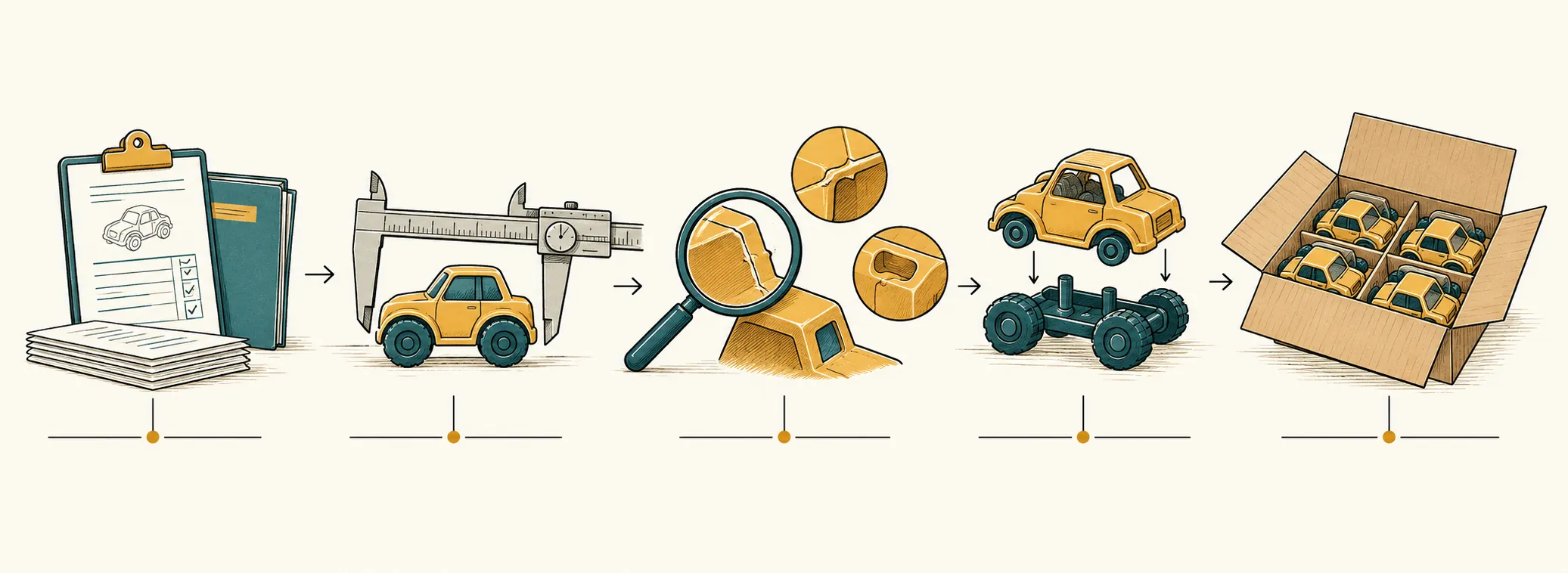
How should the six closed shipping cartons be inspected?
| 1. Carton identity and count | Inspect: count the closed cartons and group them by product identifier. Compare: purchase order and approved packing plan showing three cartons per product, six total. Discrepancy: a missing, extra or misidentified carton. Next decision: isolate the affected carton and reconcile the allocation before accepting the final packing list. |
|---|---|
| 2. Outer dimensions and units | Inspect: measure each closed carton at its longest external length, width and height in centimeters. Compare: approved packing dimensions and buyer-agreed tolerances. Discrepancy: a measurement outside tolerance, an unexplained bulge or inconsistent units. Next decision: remeasure, investigate the packing change and recalculate CBM; correct or approve the revised packing record before release. |
| 3. Gross weight and net-weight records | Inspect: weigh each sealed carton and record gross weight in kilograms. Compare: approved gross-weight range and final packing-list entries. Discrepancy: an out-of-tolerance reading or an unexplained difference between cartons with the same pack configuration. Next decision: check the scale, carton identity and packing records. Reconcile net weight through the documented contents and packaging tare; a sealed-carton gross reading alone does not verify net weight. |
| 4. Carton condition, construction and closure | Inspect: look for crushed corners, wet patches, punctures, bowed panels, split seams and incomplete closure. Compare: agreed carton construction, closure specification and any supporting strength-test record. Discrepancy: damage, substituted construction or a mismatch with the agreed strength specification. Next decision: segregate affected cartons for correction or repacking; request the agreed strength verification where necessary rather than treating a hand check as proof. |
| 5. Pieces-per-carton reconciliation | Inspect: read the quantity marks on each closed carton. Compare: approved quantities of 48 pieces per building-block carton and 24 per guitar carton, supplier packing tallies or pre-sealing count records, and the final packing list. Discrepancy: conflicting quantities or totals that do not reconcile to 144 and 72 pieces. Next decision: resolve the count through packing records or an agreed count verification. A printed quantity mark alone does not prove the contents. |
| 6. Shipping marks and carton numbering | Inspect: check product identifier, quantity, carton number, consignee or purchase-order reference, and any agreed handling marks. Compare: approved shipping-mark artwork and final packing list. Discrepancy: wrong identifier, duplicate numbering, illegible marks or inconsistent counts. Next decision: correct the marks and update the affected records before release. |
When is the piece-and-volume plan ready for shipment?
The plan is ready for shipment review when the physical carton count, confirmed packing quantities, measured dimensions, recorded weights and shipping marks reconcile with the final packing list.
Keep the original planning worksheet and the final measured version. If the packing remains three cartons at 48 pieces and three at 24, the order remains 216 pieces; if the external dimensions change, update volume without silently changing the piece count. If the packing quantity changes, obtain agreement on the revised quantity as well.
Close every discrepancy with a correction or a documented buyer acceptance within the agreed criteria. Carton acceptance is a commercial packing check, not product-safety clearance. Keep product-safety release and destination-specific paperwork as separate checks.
Sources
- Box Volume Calculator — Cubic Inches for Shipping | BoxYourBrand
Bring the question to your next brief.
Share your TF references, sales market and packaging requirements. We can discuss the details around your actual project.
Discuss your shortlist ↗ All buying insights ↗