
Shortlist the 1:24 drift car for its smaller catalog retail pack and lower unit commitment at the three-carton minimum; choose the 1:16 model when its larger window-box presentation fits your range. For wholesale remote control cars, scale alone does not establish drift control or value. Approve either model only after comparing sample steering, throttle, tires, controller, battery and included accessories against a written purchase specification.
The comparison below uses ToyFreight’s catalog snapshot dated October 17, 2026. Packing figures are catalog references, not guaranteed shipment specifications. Product-name features are identified as catalog descriptions rather than measured performance.
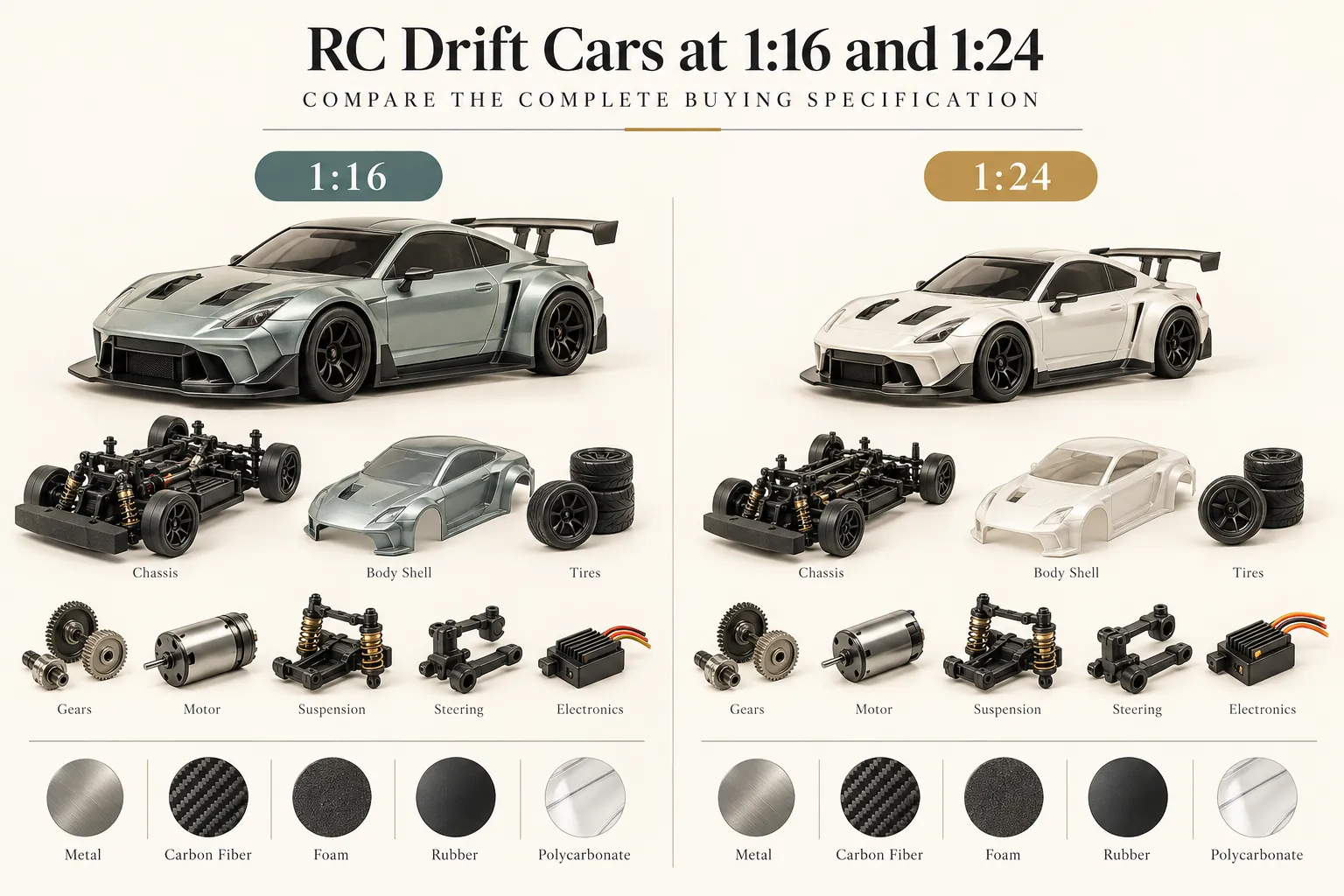
How do the two drift cars compare beyond scale?
| Catalog model reference | 1:16 — TF10658, cataloged as “1:16 Scale RC Drift Car with Dual Motors.” | 1:24 — TF10650, cataloged as “RC Drift Car, 1:24 Scale, 2.4GHz, 4WD.” |
|---|---|
| Scale and actual vehicle dimensions | 1:16 — Listed scale: 1:16; specify actual vehicle length, width and height in the purchase specification. | 1:24 — Listed scale: 1:24; specify actual vehicle length, width and height. Retail-box dimensions are not vehicle dimensions. |
| Drive layout and motors | 1:16 — Dual motors are named in the catalog; verify which wheels are driven. | 1:24 — 4WD is named in the catalog; verify the sample’s driven-wheel configuration. |
| Steering and throttle | 1:16 — Require sample confirmation of proportional or stepped steering and throttle. | 1:24 — Require the same confirmation; neither scale nor a 4WD description establishes proportional control. |
| Controller and radio | 1:16 — Specify controller layout, radio frequency, pairing procedure and controller power requirements. | 1:24 — The catalog names 2.4GHz; confirm controller layout, pairing procedure and controller power requirements. |
| Tires and included wheel sets | 1:16 — Specify tire material, fitted set, additional sets and wheel attachment. | 1:24 — Specify the same items; approve sliding behavior on the intended demonstration surface. |
| Vehicle battery | 1:16 — Specify chemistry, voltage, capacity, pack dimensions, connector and included battery count. | 1:24 — Specify the same details; do not assume batteries are interchangeable. |
| Charging equipment | 1:16 — List the supplied charging device or cable and its input requirements. | 1:24 — List the same contents and requirements; approve the charger and battery combination together. |
| Speed and runtime claims | 1:16 — Publish only model-specific results supported by an agreed test record. | 1:24 — Apply the same rule; do not transfer general 1:24 runtime claims to this model. |
| Complete retail contents | 1:16 — Approve an itemized pack-out covering car, controller, battery, charging equipment, tires, tools and instructions. | 1:24 — Approve a separate itemized pack-out rather than assuming identical contents. |
How do retail packing and carton quantities change the buying decision?
| Retail package dimensions | 1:16 — 28 × 14 × 11 cm. | 1:24 — 20.7 × 12.2 × 12.9 cm. |
|---|---|
| Retail package presentation | 1:16 — Window box. | 1:24 — The catalog records "Electricity box"; this packaging term is unclear. Confirm the exact format using the physical sample and current quotation. |
| Export carton dimensions | 1:16 — 70.5 × 56 × 66 cm. | 1:24 — 64 × 45 × 54.5 cm. |
| Quantity per export carton | 1:16 — 60 cars. | 1:24 — 40 cars. |
| Listed carton volume | 1:16 — 0.26 m³. | 1:24 — 0.16 m³. |
| Documented catalog MOQ | 1:16 — Three export cartons per model. | 1:24 — Three export cartons per model. Customization is quoted separately. |
| Units at the catalog minimum | 1:16 — 3 cartons × 60 cars = 180 cars. | 1:24 — 3 cartons × 40 cars = 120 cars. |
| Reference volume at the catalog minimum | 1:16 — 3 × 0.26 m³ = 0.78 m³. | 1:24 — 3 × 0.16 m³ = 0.48 m³. These totals use the catalog’s rounded carton-volume figures. |
| Reference carton volume per car | 1:16 — 0.26 ÷ 60 ≈ 0.00433 m³ per car. | 1:24 — 0.16 ÷ 40 = 0.00400 m³ per car. These are packing calculations, not freight quotations. |
What does the three-carton minimum mean for an opening order?
At the documented catalog minimum, the 1:24 option commits the buyer to 120 cars, compared with 180 cars for the 1:16 option—a difference of 60 cars.
Worked scenario: assume an opening order of exactly three export cartons of each model, using the listed packing configuration. The combined order is 300 cars and approximately 1.26 m³ of catalog carton volume: 180 + 120 cars, and 0.78 + 0.48 m³. This is a quantity-and-volume comparison, not a landed-cost estimate.
Use the 1:24 option if reducing the opening unit commitment is the priority. The figures do not establish which model is cheaper to buy or ship. Also, a three-carton minimum does not establish an order-multiple rule; confirm whether quantities above the minimum can include split cartons.
Which sample checks should decide the final selection?
Choose the model that meets your written control, drift and pack-out requirements on an approved sample—not the model with the larger scale number.
For a comparable commercial sample check, use the same clean, dry, smooth surface and record each model’s tire set, battery configuration and charge preparation. These are proposed comparison conditions, not a safety standard or proof of equivalent performance.
Move the steering control slowly through its travel and observe whether wheel angle changes progressively or in fixed steps. Check throttle response separately. Then compare straight-line tracking, return to neutral and the ability to repeat a controlled slide using the supplied tires. If proportional steering and throttle are essential to your assortment, make both explicit acceptance criteria rather than accepting a general “drift” label.
Operate the two samples together to check pairing and independent control under that test setup. This does not establish a universal simultaneous-car limit or compatibility with other controllers.
Inspect the complete power system: battery label, connector, compartment closure, charging equipment and controller batteries. Request instructions that match the supplied configuration. Record any runtime test with its surface, driving pattern, battery and stopping criterion; do not substitute a generic runtime estimate.
Finish with a photographed, itemized retail pack-out and a current packing specification. Prefer the 1:24 model when its smaller package and 120-car catalog minimum meet the commercial brief. Select the 1:16 model when its window-box presentation and 180-car minimum fit the range—and its sample meets the same functional requirements.
Bring the question to your next brief.
Share your TF references, sales market and packaging requirements. We can discuss the details around your actual project.
Discuss your shortlist ↗ All buying insights ↗