
Approve English and Spanish toy instruction sheets against the same physical kit, with separate owners for product accuracy, language quality, and regulatory validation. Give your OEM toy manufacturer one controlled brief covering component names, setup, reset, warnings, illustrations, and the version packed with each unit. Choose a shared bilingual insert when both language versions fit legibly; choose separate editions when the layout or destination-specific wording needs more space. Translation approval alone is not production approval.
For an activity kit, the deliverable is more than translated text: it is a component-to-instruction map, a usable printed proof, and a release record identifying who verified each part.
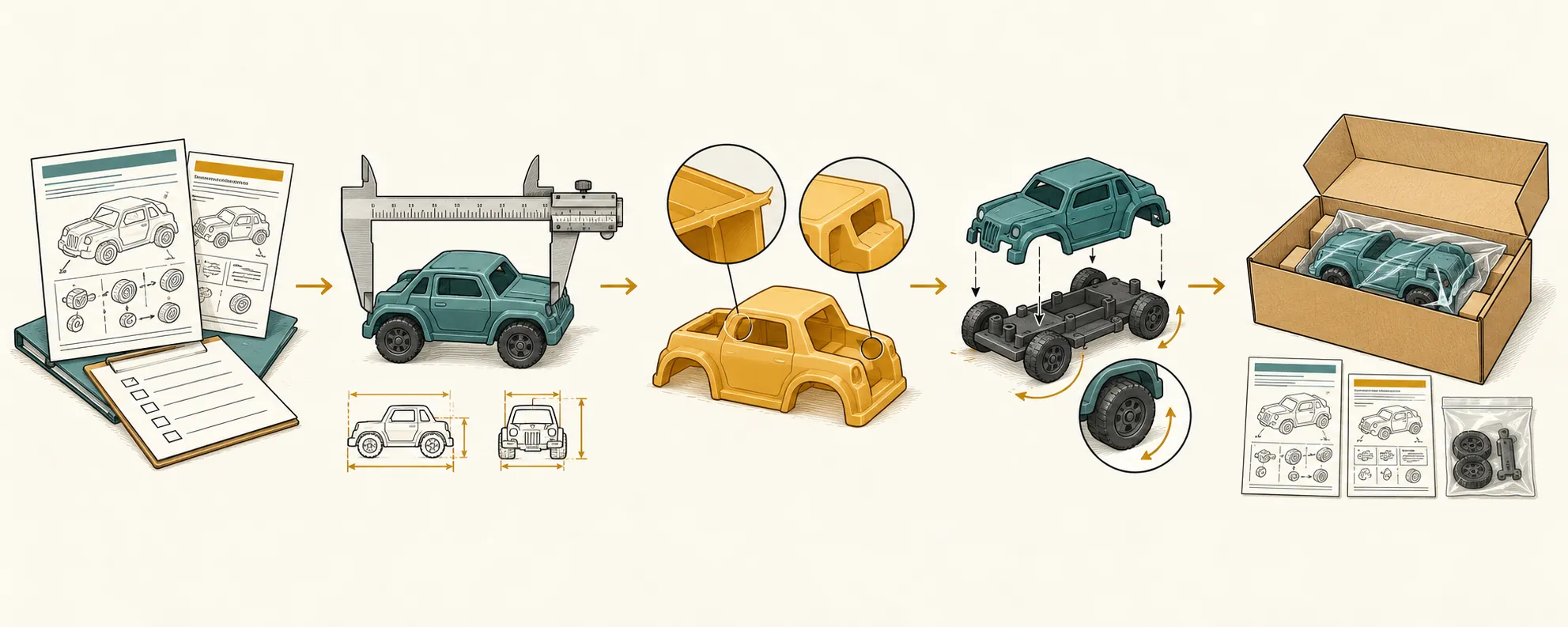
Should you choose one bilingual insert or separate language editions?
| One English–Spanish insert in every kit | Keeps one instruction edition for the agreed product configuration. Both languages must retain complete steps and approved warnings without shrinking the type or diagrams beyond the buyer's accepted layout. Confirm folded fit and insert placement in the actual package. |
|---|---|
| Separate English and Spanish editions | Provides more space for each language and permits distinct approved wording. Specify one correct edition per packaged kit and identify the destination allocation, leaflet revision, and packing instruction for each order line. |
| Two separate leaflets in every kit | Preserves independent language layouts while supplying both languages together. Quote the two-leaflet configuration per complete kit, verify package fit, and check that packing instructions require both leaflets. |
Which activity-kit details should anchor the instruction brief?
Use the physical component inventory and demonstrated operating sequence as the instruction brief's master reference. The catalog name is a starting point, not a verified parts list.
The October 17, 2026 catalog lists a scientific circuit activity kit described as 45 pieces with six cards, packed in a window box measuring 45 × 29 × 5.6 cm. Confirm the counting convention, including whether the cards are included in the piece count, against the current sample and packing list. These are catalog packing references, not guaranteed shipment specifications.
Assign each confirmed component a stable callout number. Carry that number through the English name, Spanish glossary entry, illustration, setup step, and reset instruction. Do not add a power source, accessory, or operating action merely because a similar kit uses one.
The window-box dimensions do not establish the usable space for a leaflet. Check the folded proof inside the actual package and confirm that its placement does not obscure the intended display.
What should the bilingual instruction brief contain, and who verifies it?
| Product identity and language scope | Record the exact kit configuration, quoted sales unit, intended destinations, English variant, Spanish variant, and instruction edition. Owner: buyer's product manager. Verification: configuration sheet and order-line allocation agree. |
|---|---|
| Component names | Create a photo inventory with callout number, quantity, approved English name, and approved Spanish equivalent for each confirmed component. Owner: supplier's product specialist for identity and quantity; bilingual reviewer for terminology. Verification: inventory matches the sample and diagrams. |
| Setup | Document the starting condition, component orientation, action sequence, and expected visible result for each supported activity. Owner: supplier's product specialist. Verification: buyer's technical reviewer follows the draft against the exact sample without unwritten assistance. |
| Reset and repeat use | Define the demonstrated end condition and the approved sequence for returning the kit to its next-use starting condition. Owner: product specialist, with buyer technical review. Verification: the documented sequence works on the approved configuration; any unresolved step is corrected before release. |
| Warnings and required wording | Maintain a controlled list of proposed safety messages and their intended locations. Owner: buyer-designated destination compliance reviewer for applicability and wording; bilingual reviewer for faithful translation. Verification: approved text appears in the correct language edition and artwork location. |
| Illustrations and cards | Use views that match the supplied components, with consistent callout numbers, orientation, arrows, and step order. Cross-reference the included cards where relevant to the demonstrated activity. Owner: technical illustrator and product specialist. Verification: no depicted part or action conflicts with the sample. |
| Print and packing | Specify edition ID, revision, page order, folded format, and insert placement. Owner: printer's prepress reviewer for production artwork; packing lead for insertion. Verification: the printed proof is readable and the approved edition is assigned to each packaged-kit configuration. |
How do linguistic review and regulatory validation differ?
Linguistic review checks whether the Spanish and English communicate the approved meaning; regulatory validation checks whether that content is appropriate for the exact product and destination. Neither approval substitutes for the other.
Give the bilingual reviewer the sample photographs, component glossary, diagrams, and intended country variant—not an isolated text file. Ask the reviewer to check terminology, omitted actions, negation, quantities, diagram references, and whether instructions address the same user consistently. Review the laid-out proof again after translation: correct text can still be cut off, misplaced, or paired with the wrong image.
Assign the destination compliance reviewer responsibility for confirming applicable warning content, intended-age statements, language coverage, and placement against the actual product and relevant rules. Do not infer age suitability from a product name or catalog category. An English–Spanish layout is a purchasing configuration, not evidence that all destination requirements have been met.
Keep a third approval for product accuracy. A technically incorrect setup step remains incorrect in excellent Spanish. Likewise, an approved instruction sheet does not replace applicable product safety testing.
What does one linked customization request look like?
| Product and quoted sales unit | Hypothetical request: quote one complete packaged circuit activity kit with its confirmed component inventory, six catalog-listed cards, window box, and one bilingual instruction insert. Confirm the piece-count convention and sales unit before comparing quotations. State order quantity independently from component count and carton quantity. |
|---|---|
| Product color and availability | Retain the physical reference sample's component colors, subject to buyer approval. Identify the color reference for each relevant component and propose written, measurable acceptance limits and a comparison method before production. A signed sample alone does not define a numerical tolerance. Confirm current availability and the conditions for matching future reorders. |
| Logo location and printing process | Proposed change: place a one-color black buyer logo on the front panel of the instruction insert only; leave the toy unbranded. The printer should confirm the proposed printing process, printable area, and final logo dimensions. Any logo on the toy or outer box is a separate scope change. |
| Language and content | Proposed destinations: the United States and Mexico, with English (US) and Spanish (Mexico) in the shared insert. The buyer's destination reviewer must confirm the required language coverage and wording. Use the approved component glossary, demonstrated setup and reset sequence, and matching illustrations. |
| Packaging artwork and required wording | Retain the window-box format, subject to approval of the folded insert's fit. Submit the complete insert and any affected box artwork for review. Obtain artwork format, bleed, fold, and print requirements from the selected printer; do not apply another printer's specifications automatically. |
| Verification owners | Assign the supplier's product specialist to component and operating accuracy, the bilingual reviewer to language equivalence, the buyer's destination compliance reviewer to applicable wording, and the buyer's product manager to final configuration release. |
| Approved sample and change record | Identify the retained physical sample, final printed proof, artwork revision, glossary revision, and approval date in one release record. Require written review of changes to components, colors, instructions, cards, logo, packaging, or language edition before production. |
| Commercial confirmation | Request the customization minimum, itemized charges, proofing stages, and production schedule for this exact configuration. Confirm current product availability and reorder conditions separately. Do not treat a catalog color or packing reference as a stock or shipment commitment. |
What should be checked before instruction sheets enter production?
Release the instruction sheets only after the physical kit, final language layout, and packing instruction identify the same approved configuration. A text-only approval cannot verify printed legibility, diagram placement, fold order, or package fit.
For a proposed buyer usability check, give the approved sample and printed proof to a reviewer who did not write the instructions. Have the reviewer identify the components, follow the documented setup, and complete the documented reset without coaching. Record ambiguities and revise the affected text or illustration. This is a practical instruction check, not a compliance test or a prediction of customer outcomes.
Require the packing specification to identify the correct instruction revision for every packaged kit. During the agreed pre-shipment inspection, check the inserted edition against the product configuration and destination allocation. TradeAider's manual-inspection guidance similarly recommends checking version, destination language, and correspondence between diagrams and the shipped product. TradeAider
Retain the released files and physical proof for reorders. Reopen the relevant approvals whenever a component, operating sequence, warning, translation, or package layout changes; do not carry an old instruction approval onto a changed kit without review.
Bring the question to your next brief.
Share your TF references, sales market and packaging requirements. We can discuss the details around your actual project.
Discuss your shortlist ↗ All buying insights ↗