
Accept a magnetic toy report for an order only when its tested sample and documented variant coverage can be traced to the set you will buy. For bulk magnetic tiles for kids, compare magnet enclosures, magnet specifications, component quantities, materials and model variants—not just the cover-page product name. Resolve construction differences with the laboratory before approving the order. A matching box photograph is useful identification evidence, but it does not establish that the enclosed pieces match the tested design.
What should connect the ordered sample to the test report?
Use a traceable identity record connecting the purchase specification, approved sample, component list and complete report, including its photographs and model appendices.
Record the supplier’s model designation alongside your purchasing reference, the sample’s revision or date, and the report number. Then map each distinct piece type to its construction and material specification. A sales name alone is too broad: two sets can share a collection name while containing different shapes, accessories or magnet housings.
Request written confirmation that production will follow the reviewed construction, with proposed substitutions submitted for review before use. A different purchasing code does not automatically require a new test, just as a shared model name does not automatically establish coverage. The question is whether the tested construction and documented scope support the ordered configuration.
How should buyers review sample-to-report identity?
| Model identity and revision | Compare the order designation and approved sample with the report’s model list, sample description, photographs and appendices. Record any cross-reference between purchasing and laboratory model names. Resolve unexplained differences rather than relying on a similar product title. |
|---|---|
| Magnet enclosure | Compare each magnetic piece’s dimensions, housing geometry, magnet position and closure method with the tested construction records. Request drawings or laboratory clarification where photographs cannot establish internal identity. Treat a changed enclosure or joint as a scope-review trigger. |
| Magnet specification | Match the specified magnet dimensions, quantity per piece, grade or material designation, and coating where relevant to the tested specification. Do not use attraction strength felt by hand as evidence of identity or safety. Refer substitutions to the laboratory for a coverage assessment. |
| Component count and assortment | Reconcile quantities by piece type, including spare pieces and nonmagnetic accessories. Distinguish the number of retail sets per export carton from the number of components inside one set. A matching total piece count is insufficient if the assortment or construction differs. |
| Materials and finishes | Connect each component’s material specification, colorant and finish to the report’s sample or material identification. Include accessories rather than reviewing only the magnetic tiles. Ask the laboratory to assess material substitutions or additional finishes against the existing test coverage. |
| Color, size and set variants | Check the report’s listed models and any documented representative-sample rationale. Establish which constructions and materials are shared and which differ. Do not assume that a family name covers every color, size, accessory or piece-count option. |
| Intended age and test scope | Compare the ordered labeling and intended age with the sample description, cited standard edition, applicable sections and recorded test conditions. Do not infer age suitability from a catalog category or product name. |
Castle magnetic tiles and marble-run magnetic tiles
The castle and marble-run catalog entries require separate identity mapping; their packaging references do not establish a shared tested construction.
The October 17, 2026 catalog reference for Pink Princess Castle Magnetic Tiles Building Blocks lists a color box measuring 27.5 × 7 × 21 cm and 18 packaged units per export carton. The Magnetic Tiles Marble Run entry lists a color box measuring 36 × 8.5 × 28 cm and 12 packaged units per export carton. These are catalog packing references, not guaranteed shipment specifications; confirm current packing against the order.
The useful comparison is what those quantities identify: 18 and 12 describe export-carton contents, not the components inside either retail set. Do not enter those figures as the component count in the identity review.
For the castle set, reconcile its actual piece assortment with the report’s sample description. Review the marble-run set independently, mapping each supplied tile, track part and accessory to the relevant documentation. Similar-looking tiles do not establish coverage for the rest of either set.
Which US report details should buyers check?
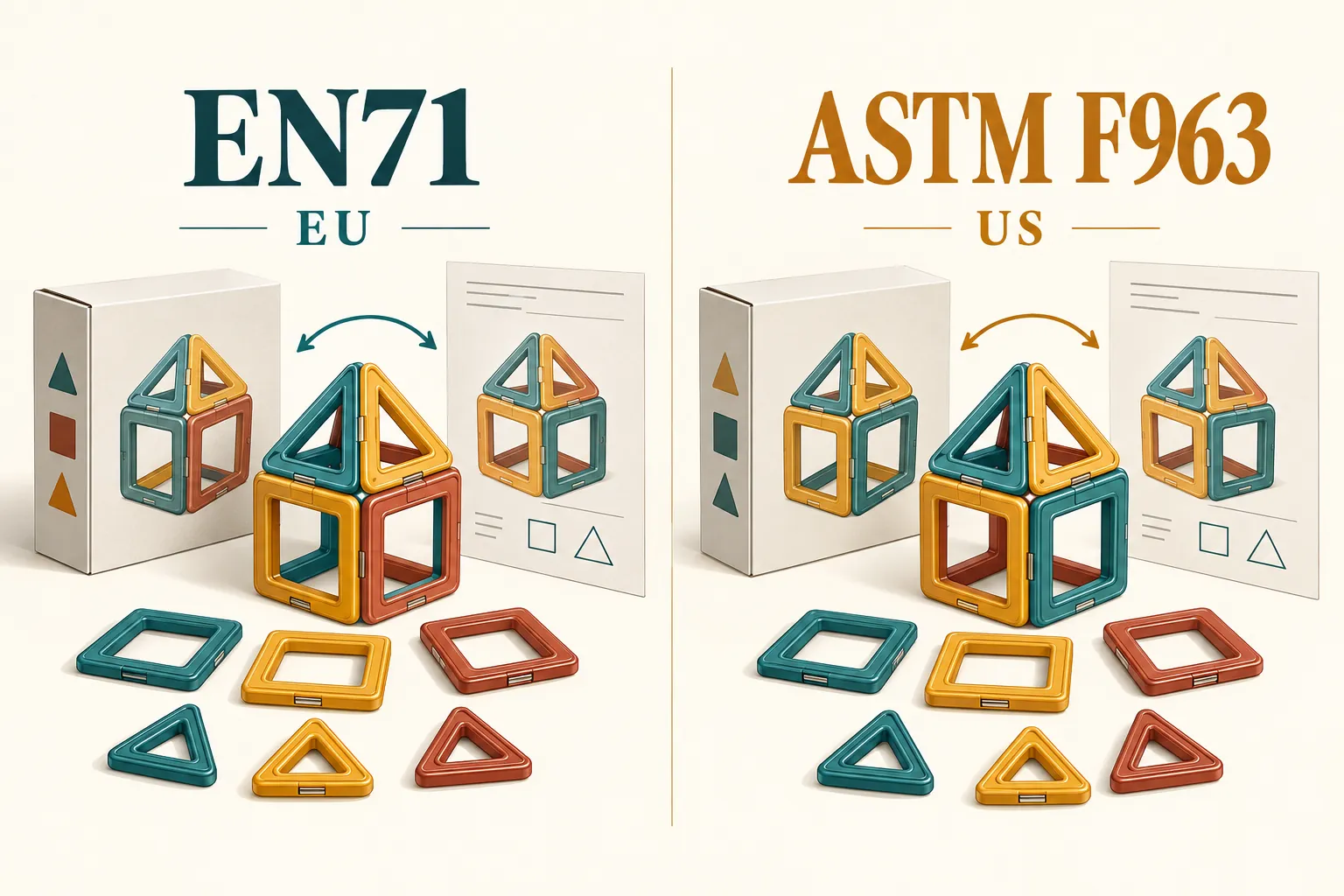
For a US order, check that the report addresses the sections applicable to the actual toy, rather than treating an ASTM F963 reference as coverage of every requirement.
ASTM F963 is incorporated through 16 CFR part 1250, and CPSC guidance states that not every section applies to every toy. Compare the report’s section list with the ordered construction and intended age. Keep this US scope review separate from the assessment for other destination markets. CPSC ASTM F963 chart CPSC toy safety guidance
Where a Children’s Product Certificate is required, CPSC guidance specifies the citation “16 C.F.R. part 1250 – Children’s toys,” followed by the applicable ASTM F963 sections. Cross-check those citations against the supporting report; the certificate does not resolve an unexplained sample or model mismatch. CPSC toy safety guidance
If the toy contains plasticized components, check the corresponding material coverage as well. CPSC identifies 16 CFR part 1307 as the phthalates citation for the certificate, rather than ASTM F963 section 4.3.8. A mechanical report match alone does not complete that material review. CPSC ASTM F963 chart
When should the buyer pause order approval?
Pause approval when a difference in enclosure, magnet specification, component assortment, material or variant scope remains unresolved; continue once the relevant coverage is documented.
As an illustrative comparison—not a test result—a larger set that repeats already reviewed pieces presents a different scope question from a set that adds a new magnetic shape or changes the enclosure joint. For the repeated-piece set, confirm that the assortment and model configuration fall within the documented coverage. For the new construction, obtain the laboratory’s assessment of whether existing results apply or additional evaluation is needed. Neither change automatically proves coverage or automatically requires a completely new report.
Do not substitute home pulling, dropping, prying or small-parts checks for laboratory compliance evidence. Visual inspection and component counting can help identify a mismatch; they cannot establish magnet-retention compliance.
Before release, retain the approved sample reference, completed identity table, supporting specifications and any laboratory clarification with the order. Make approval specific to the reviewed configuration—not to an entire magnetic-toy collection.
Sources
Bring the question to your next brief.
Share your TF references, sales market and packaging requirements. We can discuss the details around your actual project.
Discuss your shortlist ↗ All buying insights ↗