
For imported toys intended primarily for children age 12 or younger, the US importer connects ASTM F963 test reports to a CPC by matching product identity, applicable rules, and manufacture date—not by treating the report as the certificate. The report provides testing evidence; the importer issues the Children’s Product Certificate based on results from a CPSC-accepted laboratory. Before certification, reconcile the tested construction with the product being imported, confirm the applicable ASTM edition, and account for relevant production changes.
The domestic manufacturer or importer certifies compliance; a laboratory report does not replace that certification. CPSC CPC Guidance
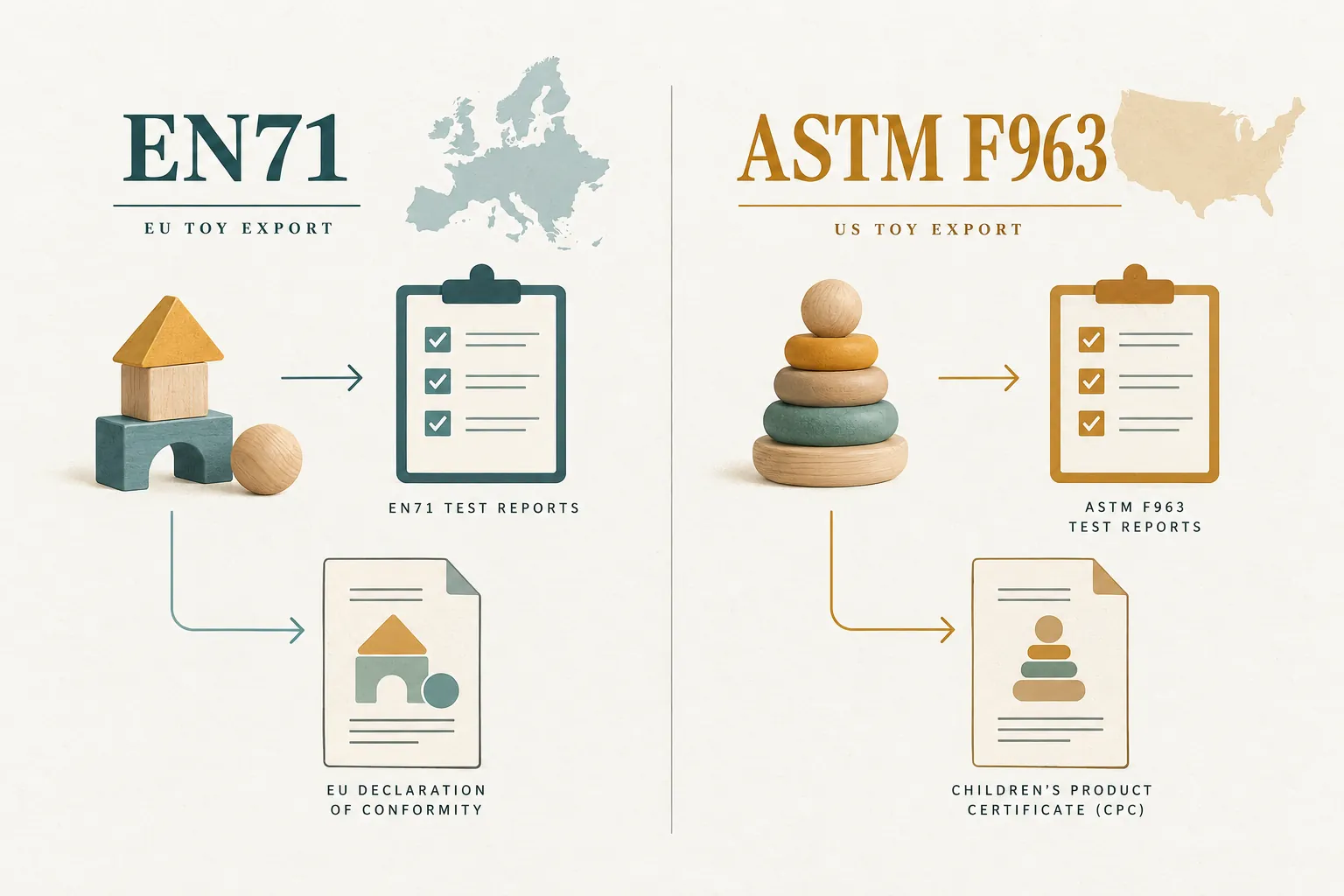
Which US toys require third-party testing and a CPC?
| Jurisdiction | United States. This crosswalk addresses CPSC toy testing and CPC certification, not certification for other markets. |
|---|---|
| Covered product and duty | Toys designed or intended primarily for children age 12 or younger: third-party testing and CPC certification to applicable children’s product safety rules. |
| Responsible party | The US importer for overseas-manufactured toys; the domestic manufacturer for toys manufactured in the United States. |
| Mandatory toy-standard citation | 16 C.F.R. part 1250 – Children’s toys, followed by the applicable ASTM F963 sections. |
| Age boundary | ASTM F963 includes toys intended for children under age 14. A toy intended for a 13-year-old audience may therefore remain within ASTM F963’s scope without requiring children’s-product third-party testing or a CPC. |
| Testing exemption or determination | When an applicable exemption or determination makes testing to a particular rule unnecessary, that rule must still be cited on the CPC. |
Who decides which ASTM F963 sections apply?
The US importer decides which ASTM F963 sections apply to an overseas-manufactured toy; that responsibility does not transfer to the supplier merely because the supplier arranges testing.
Not every section applies to every toy. Review the individual product and its construction, then compare that applicability assessment with the report’s tested sections. A report headed “ASTM F963” is not, by itself, a section-by-section applicability assessment. CPSC Toy Safety FAQ
As a purchasing control, request the report’s complete product description, photographs, tested model list, applicable sections, results, and identification of the tested construction. Resolve differences between the sample and the production product before relying on the report. These are document-reconciliation steps, not additional safety tests.
How do ASTM F963 report details connect to the CPC?
| Product identity → CPC product identification | Compare the tested model, description, photographs, and relevant variants with the product described on the CPC. If supplier and importer model names differ, keep a documented mapping that identifies the same covered product without including unrelated products. |
|---|---|
| Intended age → applicability check | Compare the intended age used for testing with the intended audience of the imported product. Resolve differences before certification because age affects both applicable toy requirements and whether children’s-product testing and CPC duties apply. |
| Tested sections → CPC rule citations | For the toy standard, cite “16 C.F.R. part 1250 – Children’s toys” followed by the applicable ASTM F963 sections. Reconcile the report’s scope with the importer’s applicability assessment; do not copy an unrelated model’s section list. |
| Other applicable rules → additional CPC citations | Identify every applicable children’s product safety rule, not just ASTM F963. Where an exemption or determination removes a testing requirement, retain the applicable rule citation on the CPC and document the basis. |
| Laboratory evidence → certification basis | Use results from a CPSC-accepted third-party laboratory. As a buyer check, verify that the laboratory’s acceptance covers the relevant testing and that the report addresses the product and requirements being certified. |
| Manufacture date → applicable ASTM edition | Use the product’s manufacture date to determine the mandatory ASTM edition. Do not substitute the purchase-order date, report issue date, or import date for this check. |
| Report applicant → responsible certifying firm | The report applicant may be a supplier, but the US importer remains the certifying party for overseas-manufactured toys. The applicant’s name on a report does not replace the importer’s CPC. |
| Construction and change records → continuing support | Check whether design, manufacturing process, component source, or manufacturer changes affect reliance on the original evidence. Apply material-change testing and periodic-testing requirements separately. |
Which ASTM F963 edition belongs in the document check?
| Manufactured February 28, 2018, through April 19, 2024, inclusive | ASTM F963-17 is the applicable edition for this manufacture-date period. Separately check the product’s identity, applicable rules, and testing support. |
|---|---|
| Manufactured on or after April 20, 2024 | ASTM F963-23 is required. A report covering only ASTM F963-17 does not, by itself, establish compliance with the required edition. |
| Report date versus manufacture date | The report date identifies the testing record; it does not determine which ASTM edition applies to the manufactured toy. |
When does a product change require testing and a new CPC?
A material change requires testing by a CPSC-accepted third-party laboratory and a new CPC. A material change is a change in design, manufacturing process, or component source that could affect compliance—not simply a new purchase order or internal model reference. CPSC Material Change FAQ
The testing scope can be narrower than a complete repeat of every original test. If a changed component does not affect other components or the finished product’s ability to comply with other applicable requirements, a new CPC may rely on the earlier initial certification testing together with the new component testing.
Changing the product’s manufacturer requires retesting and recertification. Treat that as a separate checkpoint from checking whether the product name and appearance stayed the same. CPSC Material Change FAQ
Does an ASTM F963 report expire after one year?
A report’s first anniversary is not a universal expiration date; periodic-testing duties depend on the production and testing arrangements. CPSC describes one-, two-, or three-year periodic-testing intervals depending on the qualifying testing plan and conditions under 16 C.F.R. § 1107.21. The importer is responsible for periodic testing of overseas-manufactured children’s products. CPSC Periodic Testing FAQ
Two relevant exceptions are products manufactured exclusively in short production runs of less than one year without material changes, and importers that choose to test and certify each shipment. CPSC states that these arrangements do not have periodic-testing obligations under § 1107.21.
Keep three decisions separate: the manufacture date determines the applicable ASTM edition; a material change can trigger testing and a new CPC; continued production can trigger periodic testing. Neither report age alone nor a new batch number settles all three questions.
When should an importer hold the document package for correction?
Hold certification for correction when the product cannot be matched to the evidence, an applicable rule is unaccounted for, the required ASTM edition is unsupported, or a relevant change has not been addressed.
Request a specific correction: a model-name mapping, a clarified tested-variant list, additional applicable-rule evidence, or the testing and new CPC required after a material change. A mismatch does not by itself prove that the toy fails a safety requirement, but it does need resolution before the importer relies on the package.
The useful end point is a traceable chain: the imported product matches the covered construction, the evidence supports the applicable requirements, and the responsible importer issues the CPC.
Sources
Bring the question to your next brief.
Share your TF references, sales market and packaging requirements. We can discuss the details around your actual project.
Discuss your shortlist ↗ All buying insights ↗