
Approve a toy sample only when its function, construction and complete retail pack match the agreed written specification; hold unresolved discrepancies before approving production. For a wholesale toys supplier sample, check the claimed feature, count the contents, verify the power arrangement and labels, then reset and repack the toy. Record what actually happened and who accepts each result. Only after approval should the sample become a retained production reference, alongside the specification and change records.
What should the first sample be compared against?
Compare the first sample with the agreed specification, drawings, contents list, operating instructions and packaging artwork—not with an approval reference that does not yet exist.
Before opening the pack, identify the sample version and the revisions being reviewed. Define the expected response for each control, the product dimensions and buyer-agreed tolerances, the construction description, the power configuration and the complete packed contents. Confirm whether the submission represents the intended production construction and retail packaging.
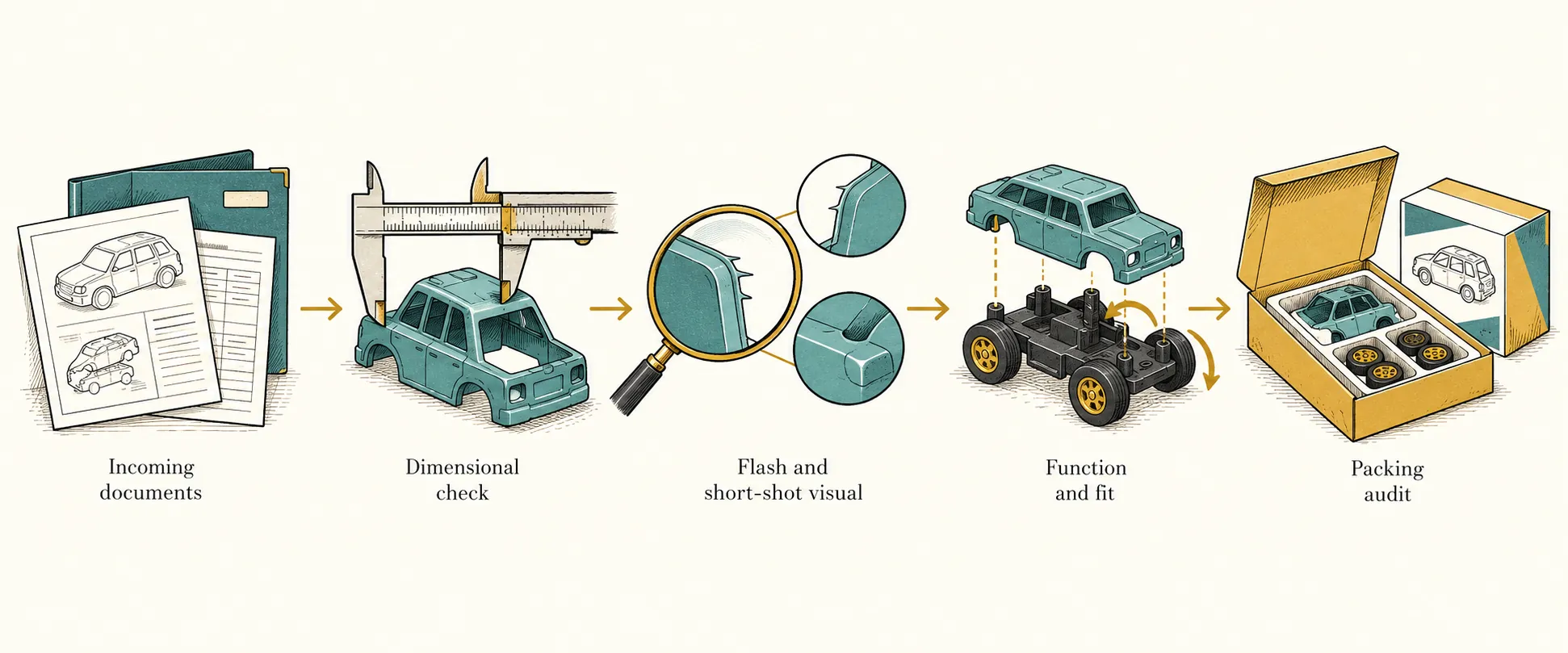
Use observable checks for alignment: measure the specified dimensions, inspect the finish and assembly, count components, and operate the toy as instructed. These are purchasing checks. QCADVISOR lists dimensions, labeling, battery compartments, sound/light functions and packaging integrity as inspection points, but its checklist does not supply a test method or acceptance limits. QCADVISOR checklist
A hand inspection does not establish regulatory safety or determine age suitability. Keep destination-specific safety review and paperwork on a separate release record. Laboratory testing scope should follow the actual design, materials, intended age and functions rather than a universal sample checklist. ECQA testing scope
Smart Electric Guitar Toy
| Catalog retail package | Color box. |
|---|---|
| Catalog package dimensions | 34.9 × 16.9 × 8.2 cm. |
| Feature to turn into a testable requirement | Translate the electric-guitar description into an agreed list of controls and expected powered responses. Test that list rather than assuming particular notes, modes or lights. |
How should buyers test the claim, the pack and the reset?
Use one recorded sequence: inspect the unopened presentation, unpack and count everything, check construction, operate each agreed function, reset the toy, then repack it.
For the guitar example, write a requirement in observable terms before testing: “Control ___ produces response ___ under power condition ___.” The blanks must be agreed, not inferred from the name. Operate the identified control and record the actual response, including any unexpected interruption. The product or engineering owner accepts the function; the sourcing manager should not sign for an undefined performance claim.
Record the power source used. If the agreed version uses batteries, record their type, quantity and condition, whether they are included for sale, and whether an isolation tab is part of the pack. Compare polarity markings, the compartment closure and any fasteners with the approved design. A closure problem is a reason to hold and escalate—not a substitute for the applicable laboratory safety test.
Define “reset” as the documented return to a usable starting state, not an assumed factory-reset feature. Follow the instructions to stop or switch off the toy, restart it and repeat the selected function. Then restore the agreed shipping state and repack every item. Check that the box closes without forcing the toy, trapping a component or unintentionally operating a control.
The sequence below is a proposed buyer inspection method. Agree any operating conditions, repeat counts and dimensional tolerances before use; they are purchasing criteria, not compliance standards or predictors of return rates.
What belongs on a printable pass/hold sample sheet?
| Sample and review identity | Product: Smart Electric Guitar Toy. Sample ID: ____. Date/reviewer: ____. Specification revision: ____. Drawing/construction revision: ____. Artwork and instructions revision: ____. Photograph references, if taken: ____. |
|---|---|
| 1. Feature claim and function | Compare: agreed control/output list. Action: operate each listed control under the recorded power conditions. Hold signal: absent, different or interrupted response against the requirement. Actual control → response: ____. Conditions: ____. Pass/Hold: ____. Acceptance owner: product/engineering ____. |
| 2. Complete contents | Compare: agreed packed contents list. Action: lay out and count the toy, accessories, instructions, inserts and any included power items. Hold signal: missing, extra, incorrect or damaged item. Actual item/count/condition: ____. Pass/Hold: ____. Acceptance owner: sourcing ____. |
| 3. Materials and construction | Compare: agreed component-level construction description. Action: check visible components, joints, attachments and assembly against the drawing; record any substitution for review. Hold signal: unexplained construction difference. Actual observation: ____. Pass/Hold: ____. Acceptance owner: product/engineering ____. Visual inspection does not verify chemical composition. |
| 4. Finish and dimensions | Compare: agreed appearance references, dimensional drawing and buyer-set tolerances. Action: inspect print alignment, coating, seams, gaps and visible damage; measure specified points using the agreed method. Hold signal: appearance mismatch or measurement outside an agreed limit. Actual measurements/observations: ____. Pass/Hold: ____. Acceptance owner: quality ____. |
| 5. Batteries or other power arrangement | Compare: confirmed power specification, inclusion statement, markings and compartment design. Action: record the actual source used, inspect the closure and operate as instructed. Hold signal: wrong power item, contradictory inclusion statement, damaged closure or mismatch with the design. Actual source/type/count/condition: ____. Pass/Hold: ____. Acceptance owner: engineering ____; safety concerns referred to compliance ____. |
| 6. Labels and instructions | Compare: agreed artwork and instruction revisions. Action: check product identity, language, placement, legibility, warnings, power information and agreement between toy, box and instructions. Hold signal: conflicting, missing or incorrect agreed content. Actual observation: ____. Pass/Hold: ____. Acceptance owner: artwork/compliance reviewer ____. Destination-specific approval reference: ____. |
| 7. Retail pack | Compare: confirmed packaging specification; catalog starting reference is a color box measuring 34.9 × 16.9 × 8.2 cm. Action: measure the box and inspect print, inserts, closure and product fit. Hold signal: difference from the agreed pack or inadequate fit. Actual dimensions/condition: ____. Pass/Hold: ____. Acceptance owner: packaging ____. |
| 8. Reset and restart | Compare: documented stop/reset/restart sequence and agreed expected response. Action: return the toy to its starting state and repeat the selected function. Hold signal: inability to restore that state or a changed response. Sequence and actual result: ____. Pass/Hold: ____. Acceptance owner: product/engineering ____. |
| 9. Repacking | Compare: agreed contents layout and shipping state. Action: replace all items, restore any specified isolation or protection, close the box and reopen it to check placement. Hold signal: forced closure, displaced contents, damage or unintended activation. Actual result: ____. Pass/Hold: ____. Acceptance owner: packaging/quality ____. |
| 10. Disposition and authorization | Overall Pass/Hold: ____. Open discrepancy IDs: ____. Correction owner and due date: ____. Reinspection scope: ____. Final sample acceptance name/date: ____. Retained reference ID after approval: ____. Separate compliance release status/reference: ____. |
What happens after a sample discrepancy?
Hold sample approval until each discrepancy is corrected, rechecked or resolved through an authorized specification change.
Record the requirement, actual observation, affected revision and responsible owner. For example, if the guitar operates as agreed but its instructions describe a different power arrangement, hold the affected sample approval and correct the instruction or product mismatch. Do not treat an operating toy as evidence that the whole pack passes.
Ask for a revised sample when the correction changes construction, fit or function. An artwork-only correction may be reviewed through a controlled proof when the acceptance owner agrees; check the physical pack again if the change affects placement, readability or fit. Recheck dependent items too—a different insert can change both packing fit and repacking.
Keep a written measurement or observation record even when photographs are unavailable. A missing photograph alone does not invalidate the review; a clear discrepancy description and traceable decision remain essential.
When does the sample become the production reference?
Create and retain the approved production reference only after the authorized reviewers accept the sample and close its discrepancies.
Identify the retained sample and packaging with the approval date and linked specification revisions. Keep the inspection sheet, operating conditions, relevant photographs and authorized changes with that reference. Do not let an old sample silently override a later written change.
Bulk inspection is the next stage: compare production units with the current specification, retained approved sample, packaging requirements and change records together. The retained sample helps resolve appearance and fit questions; it is not the only valid basis for inspection, and its approval does not replace the separate safety and destination-document review.
Sources
- Educational Toys Inspection Checklist and Template - QCADVISOR
- Toy Safety Testing Checklist | ECQA
Bring the question to your next brief.
Share your TF references, sales market and packaging requirements. We can discuss the details around your actual project.
Discuss your shortlist ↗ All buying insights ↗